Running a business often means sitting on surplus funds at some point, and a lot of companies eventually ask the same question. Can we actually invest this the way individuals do? The answer is yes, through a corporate demat account, and the process is more straightforward than most founders expect.
What Is a Corporate Demat Account?
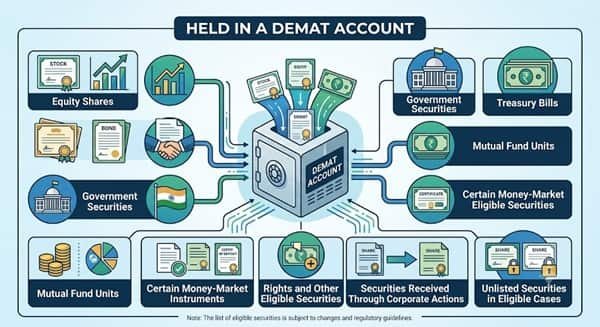
Think of it as the business version of a regular demat account. It holds shares, bonds, and mutual funds electronically under the company’s name rather than an individual’s, letting a business invest surplus funds or manage treasury holdings without dealing with paper certificates.

Who Can Open a Corporate Demat Account?
Private limited companies, public companies, partnerships, LLPs, and other registered business entities are generally eligible, as long as the entity is properly registered with the relevant authorities and has authorized signatories in place.
Documents Required for a Corporate Demat Account
- Certificate of incorporation and company PAN card
- Board resolution authorizing securities trading and naming signatories
- KYC documents of all authorized signatories
- Recent bank statements, usually the last six months
- Proof of registered office address, not older than three months
- Latest audited financial statements
How to Open a Corporate Demat Account with a Stock Broker
Step 1: Choose a Stock Broker. Look for one comfortable handling corporate demant account specifically, since not every broker offers this smoothly.
Step 2: Complete the Account Opening Form. Fill in company and signatory details accurately.
Step 3: Provide necessary Corporate Documents. This includes signatory ID proofs, Board resolutions and incorporation papers.
Step 4: Complete KYC and Verification. Authorized persons go through standard identity and address checks.
Step 5: Complete In Person or Video Verification, if Required. Some brokers ask for this extra step depending on account size or entity type.
Step 6: Account Activation. Once verification clears, usually within a day or two, the account goes live.
Eligibility and Requirements for a Corporate Demat Account
- Valid business registration with the appropriate regulatory authority
- Clean compliance standing, no pending legal or regulatory issues
- At least one fully KYC verified authorized signatory
- Active business bank account in the company’s name
- Board resolution approving securities market participation
Corporate Demat Account Charges
Charges typically include account opening fees, which some brokers waive entirely, along with annual maintenance and standard brokerage on trades. The structure mirrors individual accounts, though larger corporate volumes sometimes get negotiated rates.
How to Choose a Stock Broker for a Corporate Demat Account
- Dedicated support for business and corporate clients
- A single trading platform covering multiple exchanges
- Built in compliance tools for board resolutions and reporting
- Transparent fee structure with no hidden charges
- A responsive relationship manager to handle document heavy onboarding
Benefits of a Corporate Demat Account
- Centralizes treasury investments under one account
- Removes physical certificate handling entirely
- Speeds up settlement and reduces paperwork
- Supports multiple authorized users with defined access levels
- Gives businesses a cleaner way to deploy idle surplus funds
Corporate Demat Account vs Individual Demat Account
| Feature | Corporate Demat Account | Individual Demat Account |
| Held in the name of | The registered business entity | A single individual |
| Authorization | Multiple signatories, board approved | One person, self managed |
| Documentation | Incorporation papers, board resolution, signatory KYC | Personal PAN, ID, and address proof |
| Access control | Layered, based on authorization hierarchy | Single user access |
| Common use | Treasury management, surplus fund investment | Personal wealth building |
How to Operate a Corporate Demat Account
Authorized signatories named in the board resolution place trades and manage holdings. Larger companies often assign different authorization levels so no single person has unchecked control over the account.
Can a Company Have Multiple Demat Accounts?
Yes, a company can hold more than one demat account. This is often useful when managing separate investment purposes or working with different brokers for different business needs.
Things to Consider Before Opening a Corporate Demat Account
- Keep signatory authorizations updated as leadership changes
- Review brokerage and maintenance charges periodically
- Stay current on compliance documentation and board approvals
- Choose a stock broker that scales with the company’s needs
- Reassess account structure as the business grows or diversifies
Conclusion
A corporate demat account provides your business with a hassle-free, paperless investing platform for excess money and treasury management in one place. Select a broker that has a solid corporate support program; maintain proper documents and signatory authorizations; and periodically audit charges. If configured properly, it can be a valuable asset for your financial plan.