A Demat account is often described as an electronic locker for investments. However, unlike a physical locker, it does not store certificates or documents. It maintains electronic records of securities owned by an investor. In India, investors can access these services through a Depository Participant (DP) connected with one of the two recognised depositories, NSDL and CDSL.
But what exactly can you keep in a Demat account? The answer goes beyond ordinary company shares. Depending on the security, applicable regulations and the facilities offered by the intermediary, a Demat account can hold various types of marketable securities and investment instruments.
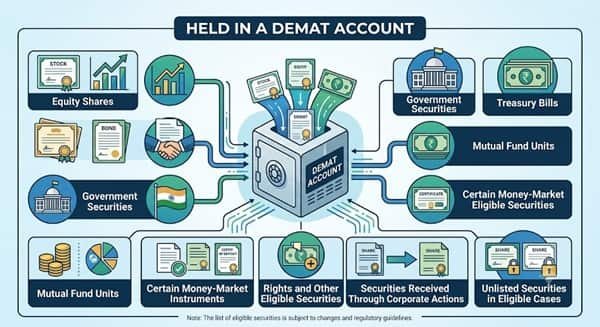
What Is Held in a Demat Account?
A Demat account is designed to hold eligible securities in dematerialised, or electronic, form. SEBI’s Depositories and Participants Regulations specifically provide for several categories of securities to be held in dematerialised form, including shares, bonds, debentures, mutual fund units, government securities and certain money-market instruments.
The exact securities available to an investor can depend on the product, regulatory requirements and the depository/intermediary involved. Therefore, a Demat account should not be thought of as a place where every type of financial asset can automatically be stored.
Here are some of the important investments that can be held through the depository system.
1. Equity Shares
Equity shares are one of the most common securities held in Demat accounts.
When an investor purchases eligible listed shares through the stock market, the shares are generally credited electronically to the investor’s Demat account after the applicable settlement process.
For example, if you purchase 100 shares of a listed company, your Demat account may show the company’s name, relevant security identification details and a quantity of 100 shares.
Holding shares electronically eliminates the need to maintain physical share certificates.
SEBI describes a Demat account as an account used to hold an investor’s securities in electronic form.
2. Bonds and Debentures
A Demat account can also hold eligible bonds and debentures.
Bonds are debt securities through which an issuer raises money from investors. Depending on the security, the issuer may pay interest according to the terms of the instrument and return the principal according to its maturity conditions.
Debentures are another form of debt instrument that may be held in dematerialised form.
SEBI’s regulations specifically include bonds, debentures and similar marketable securities among securities eligible for holding in dematerialised form.
This can be useful for investors who want their equity and eligible debt investments recorded electronically within the depository framework.
3. Government Securities
Eligible Government Securities (G-Secs) can also be held in dematerialised form.
Government securities are debt instruments issued by the government to raise funds. They can include various forms of government bonds and related securities.
SEBI’s regulatory framework includes government securities among securities eligible to be held in dematerialised form.
However, investors should distinguish between owning a government security and simply having money in a bank account. A government security is an investment instrument with its own maturity, interest and market-related characteristics.
4. Treasury Bills
Certain Treasury Bills (T-Bills) can also be held through the securities-market depository framework.
Treasury Bills are short-term government securities. They differ from longer-term government bonds primarily in their maturity structure and method of return.
SEBI’s securities framework includes government securities and money-market instruments among securities that can be held in dematerialised form.
The availability and method of holding a particular instrument should always be confirmed with the relevant intermediary.
5. Mutual Fund Units
Many investors are surprised to learn that mutual fund units can also be held in a Demat account.
SEBI’s investor material specifically describes depository services involving mutual fund units, and its investor charter includes services for mutual fund conversion into and out of dematerialised form.
However, not every mutual fund investment must necessarily be held in a Demat account. Investors may also hold mutual fund units through other permitted modes, such as directly through the mutual fund or applicable investment platforms.
This distinction is important because a Demat account is a facility for holding securities; it is not the only possible way of holding every investment product.
6. Certain Money-Market Instruments
The regulatory framework also recognises certain money-market instruments as eligible for dematerialised holding.
Examples can include instruments such as:
Commercial paper
Certificates of deposit
Certain securitised debt instruments
Other eligible instruments under the applicable framework
SEBI’s Depositories and Participants Regulations specifically list commercial paper, certificates of deposit, securitised debt and money-market instruments among securities eligible for dematerialised form.
The availability of a particular instrument in an individual Demat account depends on its eligibility and the applicable infrastructure.
7. Rights and Other Eligible Securities
A Demat account may also reflect certain rights or corporate-action-related securities or entitlements, depending on the applicable process.
For example, when a company announces a rights issue, the treatment of rights entitlements follows the rules and procedures applicable to that corporate action. Investors should read the company’s offer documents and instructions carefully rather than assuming every corporate action will appear in exactly the same way as ordinary shares.
Depositories facilitate various corporate actions, including eligible bonus issues, stock splits and rights-related processes.
8. Securities Received Through Corporate Actions
Your Demat account can also receive additional eligible securities resulting from corporate actions.
For example, suppose you own shares in a company that announces a bonus issue. If you are eligible under the terms of the issue, the additional securities can be credited electronically through the depository system.
Similarly, stock splits can result in changes to the number of securities recorded in an investor’s account according to the company’s corporate-action terms.
SEBI notes that depositories facilitate automatic credit of eligible benefits arising from corporate actions such as bonus issues and stock splits.
9. Unlisted Securities in Eligible Cases
It is also important not to assume that only exchange-listed shares can ever exist in dematerialised form.
SEBI’s regulations include unlisted securities within the securities that can be eligible for dematerialised holding, subject to the applicable framework and requirements.
However, an unlisted security is not automatically eligible simply because an investor has a Demat account. Its eligibility, dematerialisation process and applicable legal requirements need to be considered separately.
What Cannot Be Stored in a Demat Account?
A Demat account is specifically designed for securities and should not be confused with a bank or digital wallet.
You generally cannot use it to store:
- Cash or bank balances
- Physical currency
- Property ownership documents
- Gold jewellery
- Personal documents
- Insurance policies as ordinary Demat holdings
- Everyday savings
For example, if you have ₹50,000 in your bank account, that money does not become part of your Demat account simply because the two accounts are linked.
SEBI explains that investors generally use three different components when participating in the securities market: a Demat account for holding securities, a trading account for buying and selling securities, and a bank account for making or receiving payments.
Demat Account vs Bank Account
The easiest way to understand the difference is through a simple comparison:
| Feature | Demat Account | Bank Account |
| Primary purpose | Holds securities electronically | Holds money |
| Can hold shares? | Yes, if eligible | No |
| Can hold bonds? | Eligible bonds | No |
| Holds cash balance? | No | Yes |
| Used for securities records? | Yes | No |
| Used for everyday payments? | No | Yes |
This distinction is particularly important for beginners because both accounts may be connected while serving completely different purposes.
Can You Hold Different Investments in One Demat Account?
Yes, a Demat account can contain different eligible securities. For example, an investor could potentially have:
- 100 equity shares of one company
- 50 shares of another company
- Corporate bonds
- Government securities
- Eligible mutual fund units
The exact combination depends on which securities are eligible and which services are supported.
SEBI’s Consolidated Account Statement (CAS) is designed to provide a consolidated view of transactions across mutual funds and other securities held in Demat accounts.
Does a Demat Account Have a Storage Limit?
A Demat account does not work like a physical cupboard with a fixed number of compartments.
The important consideration is whether a particular security is eligible to be held in dematerialised form and whether the necessary depository and intermediary processes are available.
Investors should therefore check the relevant security’s eligibility rather than thinking in terms of a simple number of shares or investments that the account can physically “fit.”
How Can Investors Track Their Holdings?
Investors can monitor their securities through the services provided by their DP or broker and through account statements.
SEBI advises investors to regularly track their portfolio in their Demat account and promptly raise discrepancies with the DP.
Investors should check:
- Security name
- Quantity held
- Transactions
- Credits and debits
- Corporate-action entries
- Applicable charges
- Any unfamiliar transactions
Regular monitoring can help identify errors or unauthorised activity quickly.
Conclusion
A Demat account can hold much more than ordinary company shares. Depending on eligibility and applicable regulations, it can contain equity shares, bonds, debentures, government securities, Treasury Bills, mutual fund units and certain money-market or other eligible securities.
The important point is that a Demat account holds securities in electronic form, not cash or physical personal assets. The exact investments that can be maintained depend on the security, regulatory framework and depository facilities available.
For investors, understanding what a Demat account can and cannot hold makes it easier to distinguish between a Demat account, trading account and bank account—and to keep better track of an investment portfolio.