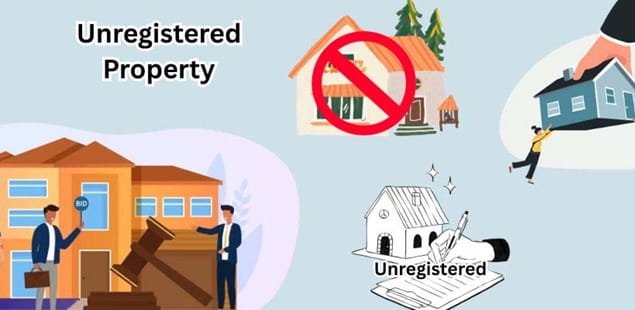
An unregistered property sale agreement can still have legal value in India, but it does not transfer ownership or title in the property. A buyer does not become the legal owner merely because an Agreement to Sell has been signed or the full price has been paid.
However, an unregistered agreement is not always useless. In certain situations, it can still be relied upon in court, especially in a suit for specific performance, where the buyer asks the court to direct the seller to execute a proper registered Sale Deed.
Key Takeaways
- An Agreement to Sell does not itself transfer ownership.
- A registered Sale Deed is generally required to transfer legal title.
- An unregistered agreement may still support a suit for specific performance.
- After the 2001 amendment, an unregistered agreement cannot normally be used to claim protection under Section 53A where registration is required.
- Stamp duty and registration are separate legal issues.
Legal Framework for an Unregistered Sale Agreement
The main laws governing this issue are the Registration Act, 1908 and the Transfer of Property Act, 1882.
Section 17 of the Registration Act, 1908
Section 17 lists the documents for which registration is compulsory. An ordinary Agreement to Sell does not automatically transfer ownership. It generally creates a contractual right to obtain another document, usually a Sale Deed, through which ownership is finally transferred.
However, Section 17(1A), introduced through the 2001 amendment, made registration compulsory for certain contracts relating to immovable property where a party seeks protection under Section 53A of the Transfer of Property Act.
This means that if a buyer relies on possession under an agreement and wants protection under Section 53A, the agreement generally needs to be registered. State laws may also prescribe additional registration requirements, so the position can vary depending on where the property is situated.
Section 49 of the Registration Act, 1908
Section 49 deals with the effect of not registering a document that was legally required to be registered. Such a document generally cannot be used to prove that rights in the property have already been transferred.
However, the proviso to Section 49 creates an important exception. It allows an unregistered document to be used as evidence of a contract in a suit for specific performance. It may also be used for certain collateral purposes, provided the party is not trying to prove indirectly what can only legally be proved through a registered document.
This is why it is incorrect to say that every unregistered property agreement is completely invalid.
Section 54 of the Transfer of Property Act, 1882
Section 54 clearly explains the difference between a sale and a contract for sale. A sale transfers ownership from the seller to the buyer. A contract for sale, commonly called an Agreement to Sell, only records that a sale will take place on agreed terms.
The section specifically provides that a contract for sale does not, by itself, create any interest or charge in the property. Therefore, even a registered Agreement to Sell is not the same as a Sale Deed. The Sale Deed is the main document through which ownership is actually conveyed.
Section 53A and the 2001 Amendment
Section 53A deals with the doctrine of part performance. In simple terms, it can protect a buyer who has acted upon a written agreement, fulfilled or remained willing to fulfil his obligations, and has taken or continued in possession of the property.
The legal position changed significantly after the 2001 amendment. For agreements executed after the amendment, registration became necessary where a party wants to rely on the agreement for Section 53A protection. Therefore, a buyer who has only an unregistered agreement should not assume that possession alone provides full legal protection.
When Can an Unregistered Sale Agreement Still Be Enforced?
The most important remedy is a suit for specific performance. Suppose a seller signs an Agreement to Sell, accepts money from the buyer and later refuses to execute the Sale Deed. The buyer may approach a civil court and seek an order directing the seller to complete the transaction.
The proviso to Section 49 allows the unregistered agreement to be considered as evidence of the contract in such a case. However, merely producing the agreement does not guarantee success.
The buyer may still need to prove that the agreement was genuine, that consideration was paid or agreed, that the buyer was ready and willing to perform his obligations, that the suit was filed within the limitation period, and that no other legal bar prevents specific performance.
When Is an Unregistered Agreement Not Enough?
It Cannot Prove Ownership
An unregistered Agreement to Sell does not make the buyer the legal owner. Even if possession has been delivered and full payment has been made, ownership normally requires a properly executed and registered Sale Deed.
It Cannot Replace a Sale Deed
The buyer cannot treat the Agreement to Sell as if it were the final conveyance document. Property tax receipts, electricity bills, possession letters, mutation entries or payment receipts may support surrounding facts, but they do not replace the registered Sale Deed where a registered conveyance is legally required.
It Cannot Normally Protect Possession Under Section 53A After 2001
Where an agreement falls within Section 17(1A), an unregistered document cannot be used to claim the benefit of Section 53A. This is particularly important in cases where the buyer has taken possession but postponed registration.
What Should a Buyer Do With an Unregistered Agreement?
A buyer holding an unregistered Agreement to Sell should first determine whether registration was compulsory in that particular transaction. It is also important to:
- check whether sufficient stamp duty was paid;
- preserve payment receipts and bank records;
- keep messages, letters and other communications with the seller;
- verify the seller’s title and encumbrances;
- check the limitation period for filing a case;
- issue a legal notice if the seller refuses to execute the Sale Deed; and
- avoid relying only on physical possession.
If the agreement is also under-stamped, the court may require the document to be impounded and the deficit stamp duty and applicable penalty to be dealt with before it can be used in evidence.
Conclusion
An unregistered property sale agreement can have limited legal validity in India, but it does not transfer ownership. It may still be used to prove the contract in a suit for specific performance and, in appropriate cases, for limited collateral purposes. At the same time, it cannot normally be used as a substitute for a registered Sale Deed or as direct proof of completed ownership transfer.
Frequently Asked Questions
Q1. Can I get a home loan based on an unregistered sale agreement?
Usually, an unregistered Agreement to Sell alone is not enough to prove clear ownership or mortgageable title. Banks generally examine title documents and require proper completion of the property transaction before accepting the property as security.
Q2. What is the validity period of an Agreement to Sell in India?
There is no single rule under which every Agreement to Sell automatically expires after a fixed period. However, a suit for specific performance is generally governed by Article 54 of the Limitation Act, 1963. The limitation period is normally three years from the date fixed for performance or, where no date is fixed, from the date when refusal becomes known.
Q3. Can an unregistered Agreement to Sell be registered later?
It may be possible if the document is still within the time allowed under the Registration Act. If the normal and extended periods have expired, the parties may need fresh documentation or legal proceedings.