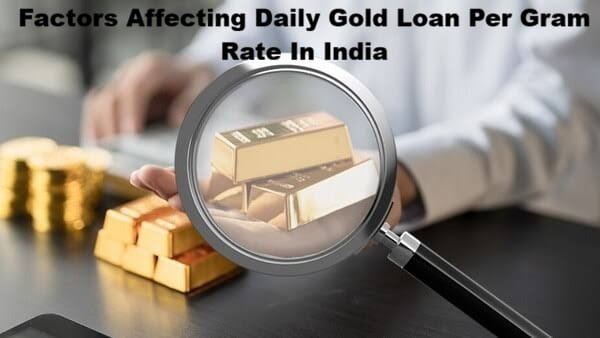
The amount a bank or NBFC is willing to lend against one gram of gold can change even when the jewellery itself remains exactly the same. A lender may quote ₹X per gram today and a different amount a few days later because gold-loan valuation is linked to changing bullion prices, purity, eligible net weight and the Loan-to-Value ratio applied to the particular loan.
This is why the gold loan per gram rate should not be confused with the retail price of gold displayed by a jewellery shop. Banks do not finance making charges, GST, gemstones or the full retail value of an ornament. They first calculate the intrinsic value of the actual gold and then lend only a permitted percentage of that value.
The Reserve Bank of India’s Lending Against Gold and Silver Collateral Directions, 2025, which lenders were required to implement no later than April 1, 2026, have also standardised how regulated lenders determine the reference price and value pledged gold.
Here are the major factors that decide the daily gold loan per gram rate in India.
What Is Gold Loan Per Gram Rate?
Gold loan per gram rate means the approximate loan amount a lender is prepared to provide against one gram of eligible gold content.
For example, suppose a lender’s assessed gold value is ₹10,000 per gram and the applicable LTV is 75%.
The theoretical loan value would be:
₹10,000 × 75% = ₹7,500 per gram
If the applicable LTV is 85%, the possible amount becomes:
₹10,000 × 85% = ₹8,500 per gram
Therefore, even with the same gold valuation, the loan per gram can differ according to the LTV applied.
1. Daily Movement in Benchmark Gold Prices
The biggest underlying factor is the market price of gold.
India Bullion and Jewellers Association, or IBJA, publishes daily opening and closing rates for different gold purities. IBJA rates are widely used as benchmark prices in India and are referenced for lending against gold jewellery.
When benchmark gold prices rise, the amount that can potentially be lent against each gram generally increases.
When benchmark prices fall, the loan value per gram can fall as well.
However, the change may not happen in exactly the same proportion as the day’s market movement because of the RBI valuation formula.
2. RBI’s 30-Day Average Rule
A lender cannot simply take the highest gold price available on the day a customer visits the branch.
Under the current RBI framework, gold collateral has to be valued using the lower of:
- The average closing price for the relevant purity during the preceding 30 days, or
- The closing price for that purity on the preceding day.
The rate must come from IBJA or an eligible SEBI-regulated commodity exchange.
Why This Matters
Suppose:
- Previous day’s 22K price: ₹10,200 per gram
- 30-day average: ₹9,900 per gram
The lender would use ₹9,900, not ₹10,200.
Now suppose gold suddenly falls:
- Previous day’s price: ₹9,600
- 30-day average: ₹9,900
The lender would use ₹9,600.
This means gold-loan valuation can respond quickly to a falling market while a sudden one-day price increase may not immediately produce the same increase in loan eligibility.
3. International Gold Prices
Indian gold prices are strongly influenced by the international bullion market.
Global gold prices can move because of factors such as:
- Expectations about US interest rates
- Inflation
- Geopolitical tensions
- Central-bank gold purchases
- Investor demand for safe-haven assets
- Global economic uncertainty
When international gold becomes more expensive, domestic benchmark rates will generally feel the effect as well.
This eventually influences the valuation used for gold loans.
4. Rupee-Dollar Exchange Rate
Gold is internationally priced largely in US dollars.
Therefore, the value of the Indian rupee against the US dollar can affect domestic gold prices.
If the rupee weakens while international gold prices remain unchanged, importing the same quantity of gold becomes more expensive in rupee terms. This can push Indian gold prices higher.
A stronger rupee can have the opposite effect.
This is one reason Indian gold prices can sometimes move differently from the headline international gold price.
5. Import Duty and Other Policy Changes
India imports a significant quantity of its gold requirement.
Changes in:
- Customs/import duty
- Government trade policy
- Import costs
can influence domestic bullion prices.
If a major duty change causes Indian benchmark gold prices to move, the effect can eventually flow into the reference valuation used by gold lenders.
However, GST and jewellery making charges themselves are not added to gold-loan collateral value.
IBJA benchmark rates are published without 3% GST and making charges.
6. Purity of the Jewellery
The number written on a weighing scale does not by itself determine how much loan the customer gets.
Purity is critical.
Common jewellery purities include:
- 22K or approximately 91.6% gold
- 20K
- 18K or 75% gold
- Lower permitted purity depending on lender policy
The RBI framework requires collateral to be valued according to its actual purity or caratage.
Therefore, 20 grams of 22K jewellery will generally support a higher loan than 20 grams of 18K jewellery, assuming all other factors are the same.
7. Net Gold Weight Rather Than Gross Jewellery Weight
Another major factor is the amount of actual gold contained in the ornament.
Suppose a necklace weighs 30 grams in total but contains:
- 4 grams of stones
- 1 gram of other non-gold material
The lender may consider only around 25 grams of net eligible gold.
RBI rules specify that only the intrinsic value of the gold contained in eligible collateral should be taken into account. Precious stones, gems and similar components cannot be added to the valuation.
This explains why a heavily stone-studded necklace may produce a surprisingly low loan amount even though it feels heavy.
8. Loan-to-Value Ratio
After determining the value of eligible gold, the lender applies the Loan-to-Value ratio.
Under the current RBI framework, maximum LTV ratios for consumption gold loans are:
| Total Consumption Loan | Maximum LTV |
| Up to ₹2.5 lakh | 85% |
| Above ₹2.5 lakh and up to ₹5 lakh | 80% |
| Above ₹5 lakh | 75% |
This creates an important situation: the same gold may support a different effective amount per gram depending on how much the customer is borrowing.
Example
Suppose eligible gold is valued at ₹10,000 per gram.
At 85% LTV:
Loan value = ₹8,500 per gram
At 80% LTV:
Loan value = ₹8,000 per gram
At 75% LTV:
Loan value = ₹7,500 per gram
The advertised “up to” per gram figure may therefore apply only to a particular loan-size category.
9. Lender’s Own Margin Policy
RBI’s LTV ratios are maximum regulatory ceilings for the relevant category.
They do not mean every lender must lend at the maximum possible percentage.
A bank or NBFC can choose a more conservative margin according to:
- Its gold-loan product
- Repayment structure
- Risk policy
- Loan amount
- Customer category
One lender may therefore offer a higher loan per gram while another gives a lower amount against jewellery of identical purity.
This does not necessarily mean one lender has valued the gold incorrectly.
10. Type of Gold Loan Product
A lender may offer several gold-loan products.
These can include:
- EMI repayment loans
- Monthly-interest servicing loans
- Bullet repayment loans
- Agricultural gold loans
- Business or income-generating gold loans
The maximum principal amount can differ depending on the repayment structure.
For bullet repayment loans, the regulatory LTV calculation must also account for the amount repayable at maturity, which includes interest.
Consequently, a bullet-loan product can sometimes produce a different initial loan amount from another repayment structure.
11. Hallmarking and Actual Assay Result
Hallmarked jewellery makes purity easier to identify, but the lender will still carry out its prescribed valuation and assaying procedure.
A hallmark does not guarantee a fixed loan-per-gram amount.
The branch may assess:
- Caratage
- Net weight
- Stones
- Fasteners
- Other non-gold materials
The final value comes from the actual eligible gold identified during appraisal.
Why Gold Loan Rates Differ Between Banks and NBFCs
Two lenders can quote different per-gram amounts on the same day because their product structures differ.
Differences can arise from:
- Internal LTV
- Margin
- Eligible purity
- Loan amount
- Repayment structure
- Product-specific conditions
Both lenders can still be operating within RBI rules.
Customers should therefore compare the final loan amount against the same jewellery, rather than comparing only an advertisement such as “up to ₹X per gram.”
Example of a Complete Gold Loan Calculation
Suppose a borrower brings jewellery with:
- Gross weight: 40 grams
- Stones and other deductions: 5 grams
- Net gold weight: 35 grams
- Eligible reference price: ₹10,000 per gram
Intrinsic gold value:
35 × ₹10,000 = ₹3,50,000
Suppose the applicable maximum LTV is 80%.
Maximum theoretical loan:
₹3,50,000 × 80% = ₹2,80,000
Approximate effective loan per eligible gram:
₹2,80,000 ÷ 35 = ₹8,000 per gram
The actual amount offered may still be lower if the lender applies a larger internal margin.
Does a Rise in Today’s Gold Price Immediately Raise the Loan Rate?
Not always.
Because lenders compare the preceding day’s closing price with the 30-day average and use the lower figure, a sudden jump in today’s jewellery-market price does not automatically produce an equivalent increase in tomorrow’s gold-loan value.
This smoothing mechanism is one reason customers sometimes see jewellery prices rising quickly while the lender’s per-gram loan rate moves more slowly.
FAQs
1. What is the best time to take a gold loan if gold prices are rising?
A rising market can improve collateral value, but the RBI valuation method uses the lower of the previous day’s closing price and the preceding 30-day average. Therefore, a sustained rise in gold prices is more likely to improve the reference valuation than a single sharp one-day jump.
2. Why did my friend get more loan per gram from the same lender?
The reason could be different jewellery purity, different net gold weight, a different loan amount or a different product and LTV. Comparing only the total weight of the ornaments does not give an accurate comparison.
3. Does the original jewellery purchase bill increase the gold loan amount?
Generally, no. The lender values the intrinsic gold content at the applicable reference price. The amount originally paid for GST, design, brand premium and making charges does not increase the collateral value.
4. Can I negotiate the gold loan per gram rate?
The benchmark valuation and regulatory LTV limits cannot simply be negotiated away. However, a lender may have different gold-loan schemes or margins, so customers can compare the final eligible amount, interest rate and charges before pledging their jewellery.