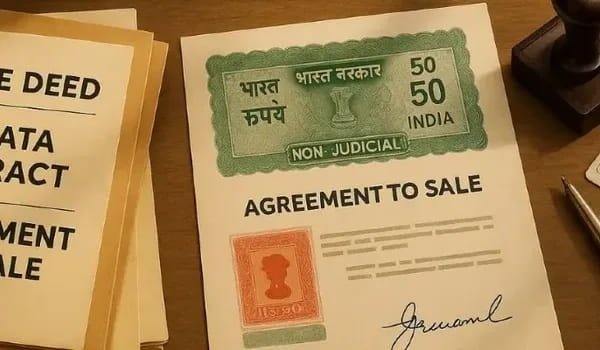
In most cases, no. If you are selling a house, flat, plot or other immovable property in India, ownership normally passes to the buyer only through a properly stamped and registered Sale Deed. An Agreement to Sell, possession letter, payment receipt, General Power of Attorney (GPA) or even full payment of the price does not by itself transfer legal title.
This is important because a buyer may pay the full amount and take possession but still not become the legal owner if the required conveyance is missing. Limited statutory exceptions exist, such as certain court or authorised public auction sales where title may pass through the auction process and a sale certificate instead of an ordinary Sale Deed.
What Is a Sale Deed and Why Is It Important?
A Sale Deed is the final legal document through which a seller transfers ownership of immovable property to a buyer for a price.
Section 54 of the Transfer of Property Act, 1882 defines a sale as a transfer of ownership in exchange for a price. For tangible immovable property worth Rs. 100 or more, the transfer can be made only by a registered instrument. In practical terms, almost every modern house, flat or plot falls within this rule.
A Sale Deed normally records:
- the names of the buyer and seller;
- complete property details;
- sale consideration and payment terms;
- possession details; and
- the rights being transferred.
Once properly executed, stamped and registered, it becomes the main document proving the buyer’s title.
What Does the Registration Act Say?
Section 17 of the Registration Act, 1908 makes registration compulsory for documents that create or transfer rights in immovable property of Rs. 100 or more.
Section 49 sets out the effect of non-registration. A document that was required to be registered generally cannot affect the property or be used as proof of the completed transfer.
So, merely signing a private document and handing over possession does not normally complete a legal sale.
Is an Agreement to Sell Enough?
No. An Agreement to Sell and a Sale Deed are different documents.
An Agreement to Sell records the terms on which the parties intend to complete the sale later. It may mention the price, advance payment, time for execution and other conditions.
Section 54 specifically states that a contract for sale does not by itself create any interest or charge in the property.
An Agreement to Sell may therefore give the buyer contractual rights, including the right to seek specific performance in an appropriate case, but it does not make the buyer the owner.
Can Property Be Sold Through GPA?
A General Power of Attorney can authorise another person to act for the owner. For example, a properly authorised attorney may sign and present the Sale Deed on the owner’s behalf.
However, the GPA itself does not transfer ownership.
In Suraj Lamp & Industries Pvt. Ltd. v. State of Haryana, the Supreme Court made it clear that GPA sales, Agreements to Sell and similar arrangements cannot replace a registered conveyance.
Therefore, a GPA can be a tool for completing a sale, but it is not the document that normally transfers title.
Does Full Payment or Possession Transfer Ownership?
No.
A buyer may have paid the full price, received possession, paid utility bills or obtained a possession letter. These facts can be relevant in a dispute, but they do not normally replace a registered Sale Deed.
Possession and ownership are different. A person may occupy or control a property without holding legal title to it.
Are There Any Exceptions?
Yes, but they are limited.
One important example is a property sold through certain court or statutory public auctions. In a court auction, title may vest in the auction purchaser when the sale becomes absolute or is confirmed according to law. A sale certificate is then issued as evidence of the sale.
Section 17(2)(xii) of the Registration Act excludes certain sale certificates issued by a Civil or Revenue Officer from compulsory registration. The Supreme Court has also recognised that a separate Sale Deed from the previous owner is not required in such cases.
Property can also pass through inheritance, gift, exchange or partition using different legal documents. These are not sales and should not be treated as shortcuts for avoiding a Sale Deed in a normal purchase.
What If the Original Sale Deed Is Lost?
Loss of the original Sale Deed does not automatically prevent a sale, but the owner must establish title properly.
Depending on the case, the seller may need to:
- obtain a certified copy from the Sub-Registrar;
- make a police complaint or loss report;
- publish a public notice;
- collect previous title and mutation records; and
- disclose the loss to the buyer.
The buyer should conduct a proper title search before proceeding. Banks may also ask for additional safeguards when original documents are missing.
Risks of Buying Property Without a Registered Sale Deed
A buyer who completes a transaction without the required Sale Deed may face:
- difficulty proving ownership;
- problems selling the property later;
- rejection of a home loan or mortgage;
- disputes with the seller or legal heirs;
- problems with mutation or municipal records; and
- expensive litigation.
The seller may also face future disputes because the transaction remains legally incomplete.
What Should a Buyer Do Before Completing the Purchase?
A safer process is to:
- Verify the seller’s ownership and previous title documents.
- Check for mortgages, court cases and other encumbrances.
- Execute a clear Agreement to Sell where needed.
- Pay the applicable stamp duty and prepare the final Sale Deed.
- Register the Sale Deed before the proper Sub-Registrar.
After registration, mutation and other local record changes should also be completed where required. Mutation is useful for revenue records, but it does not replace the title document.
Conclusion
For a normal private property sale in India, a properly stamped and registered Sale Deed is generally essential to transfer legal ownership. Agreements, GPA documents, possession and payment do not ordinarily replace it. Limited statutory exceptions, such as certain court auction sales, operate differently.
Frequently Asked Questions
Q1. Can a buyer become the owner through an Agreement to Sell?
No. An Agreement to Sell creates contractual rights but does not itself transfer ownership of immovable property.
Q2. Can I sell property if my original Sale Deed is lost?
Yes, a sale may still be possible if title is properly established. A certified copy, loss documentation, public notice and supporting records may be required.
Q3. Can a GPA holder sign a Sale Deed?
Yes, if the GPA validly authorises the person to execute the sale. But the GPA itself does not transfer ownership.
Q4. Can possession be treated as proof of ownership?
Possession may show occupation or control, but it is not by itself proof of legal title.
Q5. Can property be sold only on stamp paper without registration?
No. If the law requires a registered conveyance, merely signing a document on stamp paper is not enough.