A son can claim a share in his father’s property after the father’s death, but the right is not automatic in every case and does not mean that the son receives the entire property.
The answer depends on whether the father left a valid Will, whether the property was self-acquired or ancestral, which family members survived him, and which succession law applies. If a Hindu father dies without a Will, a son is generally a Class I heir under the Hindu Succession Act, 1956 and shares the estate with other Class I heirs such as the widow, daughters and the deceased father’s mother.
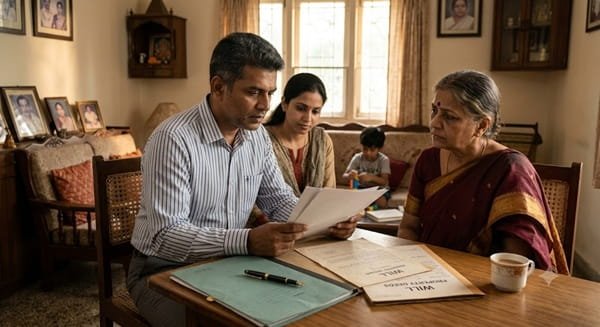
When Does a Son Get a Share in His Father’s Property?
The first question is whether the father left a Will. A person who dies without a valid Will is said to have died intestate, and the property is then distributed under the applicable succession law.
For Hindus, Buddhists, Jains and Sikhs, the Hindu Succession Act, 1956 is the main law governing intestate succession. Section 8 provides that the property of a male Hindu dying intestate first goes to the heirs listed in Class I of the Schedule.
A son is a Class I heir, but he is not the only one. The widow, daughters and mother of the deceased are also Class I heirs. Under Section 10, they generally take shares according to the statutory rules.
For example, if a Hindu father dies without a Will leaving behind his wife, one son, one daughter and his mother, each would ordinarily receive one share of the property that forms part of his estate.
What if the Father Leaves a Will?
A valid Will can change the result. A Hindu father can generally decide who will receive his self-acquired property after his death. He may leave it to one child, divide it unequally or give it to another person.
Therefore, a son cannot demand a fixed share in his father’s self-acquired property merely because he is the son if a legally valid Will disposes of that property differently.
However, a Will can be challenged in court on recognised legal grounds, for example where there is evidence of:
- forgery or fraud;
- coercion or undue influence;
- lack of testamentary capacity; or
- failure to satisfy the legal requirements for execution of a Will.
Disagreement with the father’s decision alone is not enough to invalidate a Will.
Self-Acquired Property and Ancestral Property Are Different
Self-Acquired Property
Self-acquired property is property the father acquired from his own resources or that otherwise became his separate property. During his lifetime, a son generally cannot insist on a share merely because he is the son.
If the father dies intestate, however, that property enters his estate and a Hindu son may inherit along with the other Class I heirs.
Ancestral or Coparcenary Property
The position differs for qualifying Hindu coparcenary property. In a Mitakshara joint Hindu family, coparcenary rights arise by birth. After the 2005 amendment to Section 6, daughters have the same coparcenary status as sons, a position confirmed by the Supreme Court in Vineeta Sharma v. Rakesh Sharma.
On the father’s death, it is therefore important to identify what portion actually belonged to him and what rights already belonged to other coparceners. A son cannot simply treat the entire ancestral property as the father’s estate and claim it all after his death.
What if the Father Sold or Gifted the Property Before Death?
If a father validly sold or gifted his self-acquired property during his lifetime, it generally no longer forms part of his estate. A son normally cannot claim it simply as an heir.
A challenge may still arise if the transfer itself was legally defective, fraudulent, made without authority, or involved joint or ancestral property in which other persons had enforceable rights. The nature of the property and the documents must be checked before making a claim.
Does Religion Change the Inheritance Rule?
Yes. India does not have one identical intestate succession rule for every family.
- Hindus, Buddhists, Jains and Sikhs are generally governed by the Hindu Succession Act, 1956.
- Christians are generally governed by the Indian Succession Act, 1925 for intestate succession.
- Muslim inheritance is principally governed by Muslim personal law, where the share of a son depends on the other surviving heirs and the applicable rules.
The deceased’s religion and family structure should therefore be checked before calculating any share.
How Can a Son Claim His Share After His Father’s Death?
Where the son has a legal share, the process usually starts by identifying the property and all legal heirs:
- Obtain the father’s death certificate and collect the property title documents.
- Check whether a valid Will exists and whether probate is required in the particular situation.
- Identify all legal heirs and determine the applicable succession law.
- Apply for mutation or other record changes where appropriate. Mutation helps update revenue or municipal records but does not by itself create title.
- If the heirs cannot agree on division, consider a family settlement, partition deed or, where necessary, a partition suit before the competent civil court.
The procedure may differ depending on the property and whether ownership is disputed.
Conclusion
A son can claim property after his father’s death when the applicable succession law gives him a share, but the result depends on the Will, the nature of the property and the other surviving heirs. For Hindu intestate succession, a son usually shares with the other Class I heirs rather than taking the whole estate.
Frequently Asked Questions
1. Can a son claim his father’s self-acquired property after his death?
Yes, if the father dies without a valid Will and the son is an heir under the applicable law. For a Hindu father dying intestate, the son generally inherits with the other Class I heirs. A valid Will can change that result.
2. Does a married daughter have the same right as a son?
Yes. Under the Hindu Succession Act, marriage does not remove a daughter’s inheritance rights. She is a Class I heir and has the same coparcenary rights as a son in qualifying Mitakshara coparcenary property.
3. Can a son challenge a Will that gives him no property?
He can challenge it on legal grounds such as fraud, forgery, coercion, undue influence or lack of testamentary capacity. Unequal distribution or exclusion alone is not enough.
4. Can a son claim property already gifted by his father?
Generally not if the father validly gifted his self-acquired property. A challenge may arise if the gift was legally defective or the father had no exclusive right to transfer it.