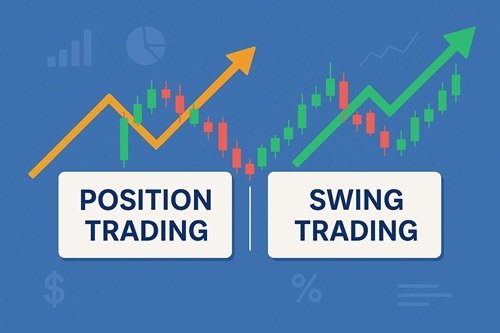
Two traders can study the same stock and see the same rising trend, yet make different decisions. One may hold it for a few days to capture the next swing. The other may hold it for months, waiting for the larger business or market trend. Both seek a price movement, but they work with different clocks, pressures and expectations.
Swing trading is faster and requires more decisions. Position trading is slower and gives a trade more time to develop, but brings longer uncertainty. Neither is automatically better. The choice depends on time, patience, capital, risk tolerance, analysis skills and the ability to follow a plan without using daily-expense money.
What Is Swing Trading?
Swing trading means holding a stock or position for more than one day, usually for several days or weeks. The trader tries to capture a price swing caused by a trend, breakout, pullback, reversal or change in momentum. The position is closed when the target is reached, the setup fails or the time-based plan ends.
A swing trader may buy after identifying an uptrend, breakout from resistance or recovery from support. The trader may study daily and four-hour charts, company news, sector strength and market sentiment. The goal is not to own a stock for years, but to benefit from a shorter move while controlling risk.
What Is Position Trading?
Position trading involves holding a market position for weeks, months or sometimes longer. The trader focuses on a broad trend rather than short-term fluctuations. The position may be based on a belief that a company, sector, commodity or index is entering a major upward or downward phase.
Position traders rely on higher time-frame charts, business performance, economic conditions, industry trends and major support or resistance. They may tolerate temporary declines if the analysis remains valid. A longer holding period still brings exposure to earnings, policy decisions, recessions and global events.
Swing Trading and Position Trading: Key Differences
1. Holding Period and Market Exposure
The clearest difference is time. Swing traders hold positions for days or weeks. Position traders may hold them for weeks, months or longer. Swing traders receive faster feedback, while position traders must accept that price may move against them several times before the larger trend becomes clear.
2. Time Commitment
Swing trading requires regular review. The trader may scan charts, track alerts and respond to breakouts, stop-losses or important news. It may suit someone who can spend time every day or every few days. Position trading demands less frequent decisions, but the trader must still review the thesis, announcements and risk exposure.
3. Capital, Leverage and Trading Costs
Swing traders may enter and exit more often, so brokerage, taxes, spreads and slippage can accumulate. Leverage increases both returns and losses. Position traders may make fewer transactions, but capital remains committed longer. If borrowed money is used, interest and holding pressure can reduce the final result.
4. Strategy and Analysis
Swing strategies focus on trendlines, breakouts, moving averages, support, resistance, volume and short-term momentum. Results and sector news may also matter, but entry and exit usually follow a nearer-term setup. Position strategies give greater importance to long-term trends, business performance, valuation, economic cycles and industry strength.
5. Risk and Emotional Pressure
Swing trading creates pressure because the trader expects a result soon. A failed breakout can produce a quick loss, and repeated decisions may lead to overtrading. Position trading tests patience. A position may remain negative for weeks, and the trader must decide whether the weakness is temporary or signals a wrong idea.
6. Profit Expectations and Flexibility
Swing traders may seek smaller moves more frequently, although losses are unavoidable. Position traders usually seek a larger trend and accept fewer but longer trades. Swing trading offers more opportunities but demands attention. Position trading gives more analysis time but can tie up capital and limit new opportunities.
Which Is Better for You?
Swing trading may fit someone who can review the market regularly, enjoys technical analysis, makes quick decisions and accepts frequent small losses. It suits shorter holding periods and active involvement. The trader still needs a written entry, target, stop-loss, position-size limit and loss limit.
Position trading may suit someone with a job or other responsibilities, patience and the ability to tolerate overnight and weekend risk. It suits company research, economic trends and higher time-frame charts. The trader must accept longer drawdowns, blocked capital and major-event risk.
Beginners should not choose a style because it looks easy or promises quick income. Study both, practise with historical or simulated trades and record which method can be followed consistently. The better style fits the trader’s schedule, knowledge, finances and discipline.
Final Thoughts
Swing trading is faster, more active and focused on shorter price movements. Position trading is slower, trend-oriented and designed to capture a broader move. Swing trading provides quicker feedback, while position trading gives more research time. Both can lose money when analysis is wrong, the position is too large or the exit plan is ignored.
Choose the method you can understand, practise and follow without emotional decisions. Protect capital, avoid household money, use sensible position sizing and review every trade honestly. Rules, charges and market conditions can change, so verify current information before acting.
Frequently Asked Questions
Q1. Can a swing trade later become a position trade?
It can, but the change should be planned. A trader may decide that the larger trend remains attractive, but should create a new plan with a suitable stop-loss, time horizon and capital limit. Holding a losing swing trade to avoid accepting a loss is not position trading.
Q2. Is position trading safer than swing trading?
Not automatically. Position trading involves fewer decisions, but remains exposed longer and can face more company, economic and overnight events. Swing trading limits the holding period, but faster decisions and repeated entries create risks. Safety depends on research, position size, risk control and discipline.
Q3. Can the same stock be used for both swing and position trading?
Yes. The same stock may offer a short-term breakout for a swing trader and a long-term growth thesis for a position trader. However, the entry reason, chart time frame, target, stop-loss and review schedule should be separate. Do not mix the plans without recording the change.
Q4. How often should a position trader review an open trade?
There is no universal schedule. A position trader may review the higher time-frame chart and major company or economic developments weekly, while checking urgent news sooner. The goal is to monitor information that can invalidate the thesis without reacting to every small movement.